[kubernates] 007. PV/PVC, Deployment, Service, HPA
Understanding "PV/PVC, Deployment, Service, HPA" via Application

- hpyYh
- 2 min read
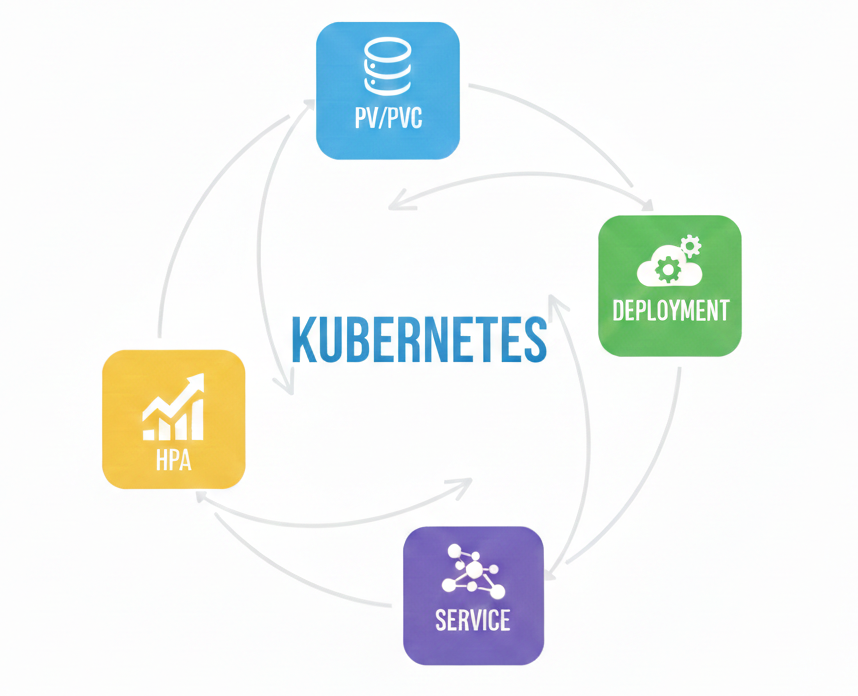
PV
- The reason for using PV/PVC is that data created inside a container is lost when the container is deleted.
- This PV is a node-local storage that can only be mounted on k8s-master
nodeAffinity:
  required:
    nodeSelectorTerms:
      - matchExpressions:
        - {key: kubernetes.io/hostname, operator: In, values: [k8s-master]}
- Use /root/k8s-local-volume/1231 on the k8s-master node as the storage path.
local:
  path: "/root/k8s-local-volume/1231"          //Use this path as a volume
PVC
- Connect a Pod to a PV.
- The resources and accessModes specified in the spec are informational and may differ from the actual underlying storage.
Deployment
- strategy
- Recreate: Deletes all existing Pods before creating new ones. This causes service downtime.
- RollingUpdate: Creates new version Pods first and deletes old ones one by one after the new ones are ready.
- maxUnavailable: The maximum number of Pods that can be unavailable during the update (e.g., at 25%, 1 out of 4 Pods is restarted at a time).
- maxSurge: The maximum number of additional Pods that can be created above the desired replica count during the update.
- Updates & Rollbacks: An update is triggered if any part of the template changes. Old ReplicaSets are kept to allow for quick rollbacks.
Service
- Service Types:
- NodePort: Connects an internal port to an external port on the node.
- ClusterIP: For internal communication only. Access via service-name.namespace:port instead of a raw IP.
- Service Discovery Example: http://service-name.namespace:port/version
- Service Registry: Acts as a load balancer during deployment to distribute traffic.
HPA
- Calculation Logic: $Current\ Pods \times (Average\ CPU / Target\ CPU) = New\ Pod\ Count$
- Behavior : Prevention of Flapping
- scaleUp.stabilizationWindowSeconds: Prevents rapid scaling out.
- scaleDown.stabilizationWindowSeconds: Prevents rapid scaling in.
- tags :
- Kubernetes ,
- Main